
Vectored_Illus
Discovering the concept of force
In everyday life, many actions on objects are described by the word force: you push a door, the wind pushes a leaf, the Earth attracts an apple. In physics, we use the model of force to represent and analyze these actions.
A force is like an identity card for an action: it does not show the "real" action, but gives all the information needed to describe and compare it.
The four characteristics of a force
Point of application
The precise location where the force acts on the object
Line of action
The line of action (vertical, horizontal, or inclined)
Magnitude
The length of the arrow represents the magnitude in newtons (N)
Direction
The arrowhead indicates where the force is directed
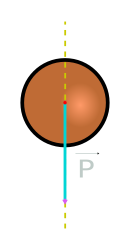
Example : the weight of a 10 kg object
- Point of application: center of gravity of the object.
- Line of action: vertical line passing through the object and the center of the Earth.
- Direction: downwards (towards the center of the Earth).
- Magnitude: calculated using the formula $P = m \times g$, with $g \approx 9.81\ \text{N/kg}$ (often rounded to $10\ \text{N/kg}$, unit also written m/s²), so $P = 10 \times 9.81 \approx 98.1\ \text{N}$
Vectored_Illus
Key points
- What are the four elements needed to describe a force?
- What is the point of application of an object's weight?
- What is the unit used to measure a force?