Light

Level 1

The straight propagation of light

Light travels in a straight line. This phenomenon is visible for example when a sunbeam passes through a dusty room: a straight and clear path can be seen.

The light ray model

To model light, we use the light ray model:

  • Light is represented by a straight line with an arrow indicating the direction of propagation.

Several rays form a light beam. Only the outer rays will be represented to simplify diagrams, but there is indeed an infinite number of rays between these two rays.

Vectored_Illus
Rayon lumineux Rayon extrême supérieur Rayon extrême inférieur

Types of light sources

We consider 2 types of light sources

  • Primary sources that produce their own light (such as the Sun, a lamp, a candle, a screen or a firefly).
  • Secondary sources that do not produce light but reflect the light they receive (such as the Moon, walls, books, faces, or any other objects).

🔄 Rotate your screen to interact with the simulator

Shadow formation

An opaque object placed in front of a light source blocks certain rays, creating areas without light. Several zones can be distinguished:

  • The own shadow zone: part of space behind the object that is not lit.
  • The cast shadow: projection of the shadow onto a surface behind the object.

Click to turn on the light

Vectored_Illus
Source de lumière Objet opaque Zone d'ombre Ombre Portée

Conditions for seeing an object

Whether or not we can see an object (with our eyes or a camera) depends on two conditions:

  • The object to be seen is illuminated. Light is therefore present
  • The light reflected from the object reaches the observer's eyes (or the camera lens)

Three optical phenomena

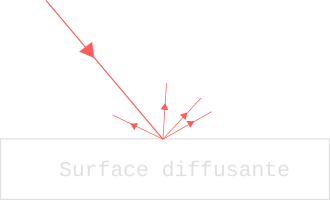
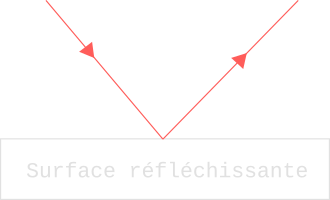
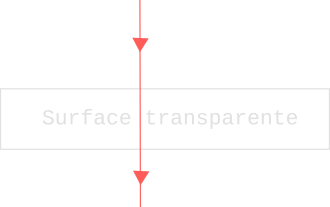
Light interacts differently with the matter it encounters. It will generally be either scattered, reflected, or transmitted. In some cases, it can be absorbed.

  • Image
    Diffusion lumineuse

    Scattering

    Light sent back in all directions by the surface.

    Examples: white wall, paper, cloud

  • Image
    Réflexion lumineuse

    Reflection

    Light sent back in a single direction.

    Examples: mirror, still water surface

  • Image
    Transmission Lumineuse

    Transmission

    Light passes through the object while continuing to propagate.

    Examples: window pane, clear water, glass

A Brief History

For a long time, light was believed to be instantaneous. In the 17th century, Galileo attempted to measure its speed without success. In 1676, Ole Rømer used observations of Jupiter's moon Io to prove that light does have a finite speed and therefore takes time to travel.

Current Value

Today, we know that c = 299,792,458 m/s (or approximately 300,000 km/s). Light can travel around the Earth roughly 7.5 times in one second.

Applications

Knowing the speed of light allows us to calculate distances by measuring the time between the emission and reception of light. It simply requires applying the speed formula. This principle is found in:

  • Laser rangefinder: measures distance by timing the round trip of a beam.
  • Light-year: the distance light travels in one year (≈ 9.46 × 10¹² km). Used to measure distances between stars in the Milky Way.

Limitations of the Light Ray Model

The light ray model helps explain many optical phenomena. However, it cannot account for colors, interference, or the fundamental nature of light. This is why a new model replaced it.

Wave Model

Light is an electromagnetic wave capable of propagating through a vacuum. It still travels in a straight line (like a light ray), but it now possesses the properties of a wave.

The Electromagnetic Spectrum

The electromagnetic spectrum encompasses all electromagnetic waves classified by frequency. It is divided into different regions:

Hover over a region to learn more

Vectored_Illus
Domaines Electromagnétique Lumière V isible Rayon Gamma Rayon X UV Infra Rouge Micro-ondes Ondes radio 10 10 10 10 6 9 12 15 18 21 Fréquence (Hz) 10 10
Note that visible light makes up only a very small fraction of all electromagnetic waves in the universe.

Advantages of the Wave Model

Thanks to this model, we can explain:

  • Colors: each frequency corresponds to a different color.
  • Propagation in a vacuum.
  • Phenomena such as rainbows or interference.