pH

Level 1

What is pH?

pH is a value used to determine whether a solution is acidic, neutral or basic. It is a measurement scale ranging between 0 and 14. It can be compared to a "chemical thermometer".

The pH scale

  • A pH of 7 corresponds to a neutral solution, like pure water.
  • A pH below 7 indicates an acidic solution. The closer the value is to 0, the stronger the acidity.
  • A pH above 7 indicates a basic (or alkaline) solution. The closer the value is to 14, the stronger the basicity.

  Example:

  • Lemon juice has a pH ≈ 2 (acidic).
  • Tap water has a pH close to 7 (neutral).
  • Soap has a pH ≈ 9 (basic).

pH in everyday life

The pH of the water we drink must be close to 7 so that it is neither too acidic nor too basic. Every liquid in our daily lives has its own pH: saliva, drinks, household products...

0 7 14

Current pH: 7.0
Neutral zone
💧 Pure water
Pure water has a pH of 7, it is neither acidic nor basic.

Why measure pH?

Measuring pH is essential to verify that a liquid is not too acidic or too basic, and therefore dangerous or corrosive.

Measurement methods

There are three main tools to measure pH:

pH paper strips

pH paper strips

They change color depending on the liquid. You simply compare the color with a reference scale.

Simple and fast Not very precise
Color indicators

Color indicators

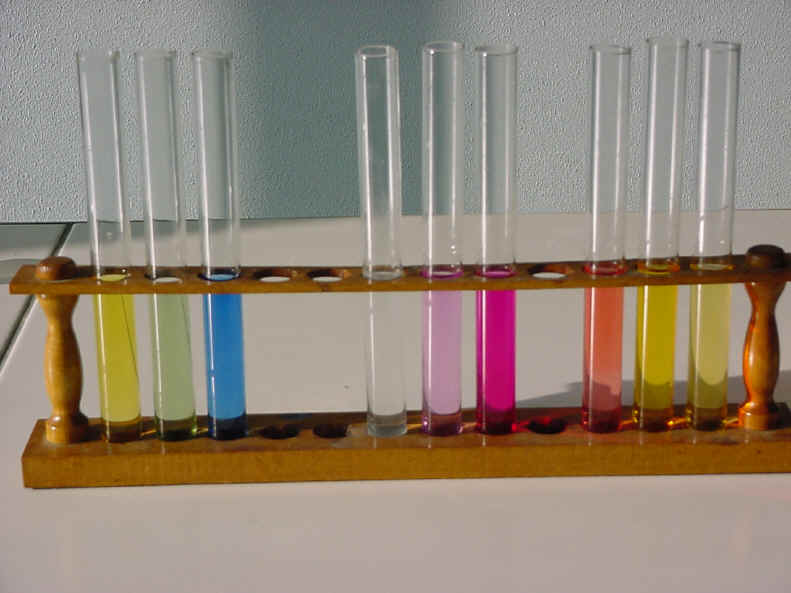
Certain substances, like red cabbage juice, change color depending on the acidity or basicity of the solution.

Visual and educational
Electronic pH meter

pH meter

An electronic device that gives the precise pH value using a probe and a digital display.

Precise and reliable Ideal for the laboratory

The role of ions

pH stands for potential of hydrogen. It indicates the concentration of hydrogen ions H⁺ in a solution. These ions, associated with hydroxide ions OH⁻, determine whether a solution is acidic, neutral or basic.

The balance of ions

  • At pH = 7: there are as many H⁺ ions as OH⁻ ions → the solution is neutral.
  • At pH < 7: there are more H⁺ ions than OH⁻ ions → the solution is acidic.
  • At pH > 7: there are more OH⁻ ions than H⁺ ions → the solution is basic.

  Example:

  • In lemonade (pH ≈ 3), the concentration of H⁺ ions is very high.
  • In a washing solution (pH ≈ 12), OH⁻ ions dominate.

The relationship between H⁺ and OH⁻

The more H⁺ ions a solution contains, the fewer OH⁻ ions it contains, and vice versa. It is this balance that explains the pH scale from 0 to 14.

pH = 7.0
H⁺ Hydrogen ions
 
 
Medium concentration
Balance
OH⁻ Hydroxide ions


Medium concentration
At pH = 7, there are as many H⁺ ions as OH⁻ ions → the solution is neutral.

Reactions of acids

Acids are not just low pH solutions: they are reactive substances that can chemically transform other materials. Let's discover two important types of reactions.

Acid + metal reaction

When certain metals are placed in an acid, a chemical reaction occurs:

  • The metal gradually dissolves
  • Gas bubbles form on the surface
  • The solution may heat up

The products of the reaction can then be tested using the appropriate characteristic tests

General equation

$
\text{Metal} + \text{Acid} \longrightarrow \text{Salt} + \text{Hydrogen}
$
 

Example: 

$
\text{Zinc} + \text{Hydrochloric acid} \longrightarrow \text{Zinc chloride} + \text{Hydrogen}
$

$
\mathrm{Zn} + 2\,\mathrm{HCl} \longrightarrow \mathrm{ZnCl_2} + \mathrm{H_2}
$

 
Note that not all metals react, or react very little, with acids: copper,  silver,  gold,  platinum.
Conversely, some metals like magnesium react very violently with acids!


Acid + base reaction 

When an acidic solution and a basic solution are mixed, the H⁺ ions of the acid react with the OH⁻ ions of the base. Be careful, these mixtures often produce a lot of heat! Great care must be taken.

General equation

$
\text{Acid} + \text{Base} \longrightarrow \text{Salt} + \text{Water}
$
 

The ions react as follows: $\mathrm{H^+} + \mathrm{OH^-} \longrightarrow \mathrm{H_2O}$

Example: 

$\text{Hydrochloric acid} + \text{Sodium hydroxide} \longrightarrow \text{Sodium chloride} + \text{Water}$

$\mathrm{HCl} + \mathrm{NaOH} \longrightarrow \mathrm{NaCl} + \mathrm{H_2O}$

Evolution of pH 

When gradually adding a base to an acid:

  • The pH increases gradually
  • When there are as many H⁺ ions as OH⁻ ions, the pH reaches 7: complete neutralisation
  • If you continue adding base, the pH exceeds 7 and the solution becomes basic

The reverse is true if an acid is added to a base.