Image

The matter around us – like air, water or our body – is made up of molecules. But looking closer, we discover that these molecules are themselves made of even smaller particles: atoms.
Imagine a piece of sugar being cut in half, then in half again, indefinitely. At the end of the process, we would obtain atoms: the fundamental "building blocks" of all matter.
At the beginning of the 19th century, John Dalton proposed a simple model: each atom is a small solid sphere. When several of these spheres combine, they form a molecule.
Examples:
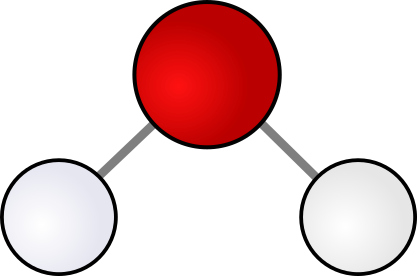
A water molecule = 2 hydrogen atoms + 1 oxygen atom
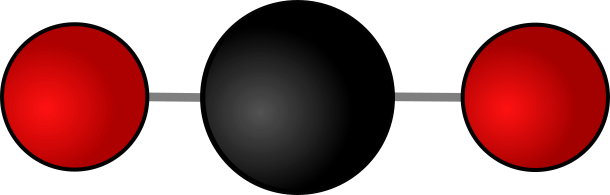
A carbon dioxide molecule = 1 carbon atom + 2 oxygen atoms
The colours used to represent atoms in models are not real, but they help to distinguish them visually.
Out of more than 100 different types of atoms, 4 are very common in biological molecules:
Each is represented by a chemical symbol: a capital letter, sometimes followed by a lowercase letter.
Thus with the symbols of each atom, we can write the chemical formula of the molecule to give its composition. We write the symbol of the atom followed, as a subscript, by the number of atoms present in the molecule.
Note that if there is only one atom, we do not write the 1 to simplify the notation.
Example
For water, which has 2 hydrogen atoms and one oxygen atom. This gives us $H_2O$
For carbon dioxide, which has 2 oxygen atoms and 1 carbon atom, the formula is : $CO_2$
The word "atom" comes from the Ancient Greek atomos, which means "indivisible". Ancient Greeks had already imagined this idea around 400 BC. It was then forgotten for centuries, then validated by scientific experiments in the 19th century.
At the beginning of the 20th century, the physicist Ernest Rutherford performed a landmark experiment. He bombarded a thin gold foil with particles. To his great surprise, most passed through the foil, but some were deflected or bounced back. This means that the atom is not a solid sphere!
An atom consists of:
An atom is therefore mainly made up of empty space between the nucleus and the electrons: this is called a lacunar structure.
An atom is overall electrically neutral:
If an atom loses or gains electrons, it becomes an ion (positive or negative).
The nucleus is made of nucleons:
An atom is written in the following way:
$^A_ZX$
Example: For $^{12}_6C$ the atom is composed of:
The periodic table is attributed to Dmitri Mendeleev, who proposed a classification of elements based on the recurrence of chemical properties. Certain atoms have similar properties and are grouped together.
Thus, certain columns or blocks correspond to families of elements, all having similar chemical properties.
Example:
alkali metals in the first column, which tend to lose 1 single electron and are very reactive (especially with water).
Atoms are ordered by increasing atomic number.

Bohr proposed that electrons are arranged in shells around the nucleus:
Electrons fill the shells closest to the nucleus first (from 1 to 3).
An atom is stable when its outer shell is full. A stable atom tends to react less; otherwise, it seeks to react to stabilize itself:
Examples:
Each shell is divided into subshells in which the electrons are distributed.
There are 4 types of subshells:
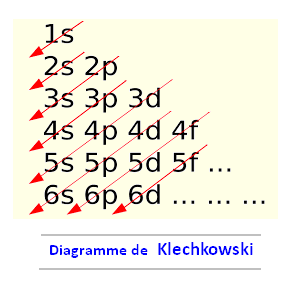
To fill subshells in the correct order, Klechkowski's rule is used
Examples: